
Some old recipes are remarkable not because they contain unusual ingredients, but because they show just how much can be made from the simplest things.
Potatoes, eggs, milk, butter and flour are all familiar staples. On their own, they may not seem especially inspiring. Layered together, however, they become a warm and nourishing casserole with creamy mashed potatoes, sliced hard-boiled eggs and a generous layer of béchamel sauce.
I found this recipe in an older collection of regional Quebec cooking, where it was associated with the Fjord-du-Saguenay area of Saguenay–Lac-Saint-Jean. Its original French name, Mets aux œufs et aux pommes de terre, translates quite simply as “egg and potato dish.”
That modest name suits it rather well. This is not elaborate cooking. It is an economical family meal built from ordinary ingredients and prepared with care—the very kind of recipe I hoped to rediscover through From Quebec’s Old Kitchens.
A simple meal from Saguenay–Lac-Saint-Jean
Located north of Quebec City, Saguenay–Lac-Saint-Jean has a rich culinary identity shaped by its climate, agriculture and strong traditions of family and community cooking.
The region is especially known for substantial dishes such as tourtière, but its everyday cooking also includes quieter recipes like this one: practical meals designed to nourish a family using ingredients that were affordable and readily available.
This casserole does not require meat, expensive cheese or specialty ingredients. Eggs provide the protein, potatoes make the dish satisfying, and a simple white sauce brings the layers together.
It is a lovely example of resourceful home cooking—and one that still makes sense in a modern kitchen.
What is an egg and potato casserole?
The original recipe is assembled in three distinct layers.
The first is a seasoned mashed potato mixture enriched with butter, milk and chopped parsley. Half of it is spread in the bottom of a baking dish.
Sliced hard-boiled eggs are arranged over the potatoes and covered with homemade béchamel sauce. The remaining mashed potatoes are then added on top before the dish is baked until hot and lightly golden.
The result is soft, creamy and pleasantly mild. It has the comforting character of a cottage pie, but the eggs replace the usual meat filling.
Because the flavours are intentionally simple, the casserole works particularly well with a crisp or slightly acidic side dish, such as a green salad dressed with mustard vinaigrette, pickled beets or seasonal vegetables.
Bringing an old recipe into today’s kitchen
I have kept the ingredients and construction of the regional recipe very close to the version I found.
The original begins with already-prepared mashed potatoes. To make this version more useful as a complete recipe, I have included an approximate quantity of whole potatoes and instructions for cooking them.
I have also clarified the preparation order. Boiling the potatoes and eggs first allows the béchamel to be made while they cook, making the recipe easier to prepare without changing its character.
This is not presented as the only traditional version of the dish. It is a regional recipe found in an older Quebec cookbook, carefully adapted for today’s home cook while preserving its original simplicity.
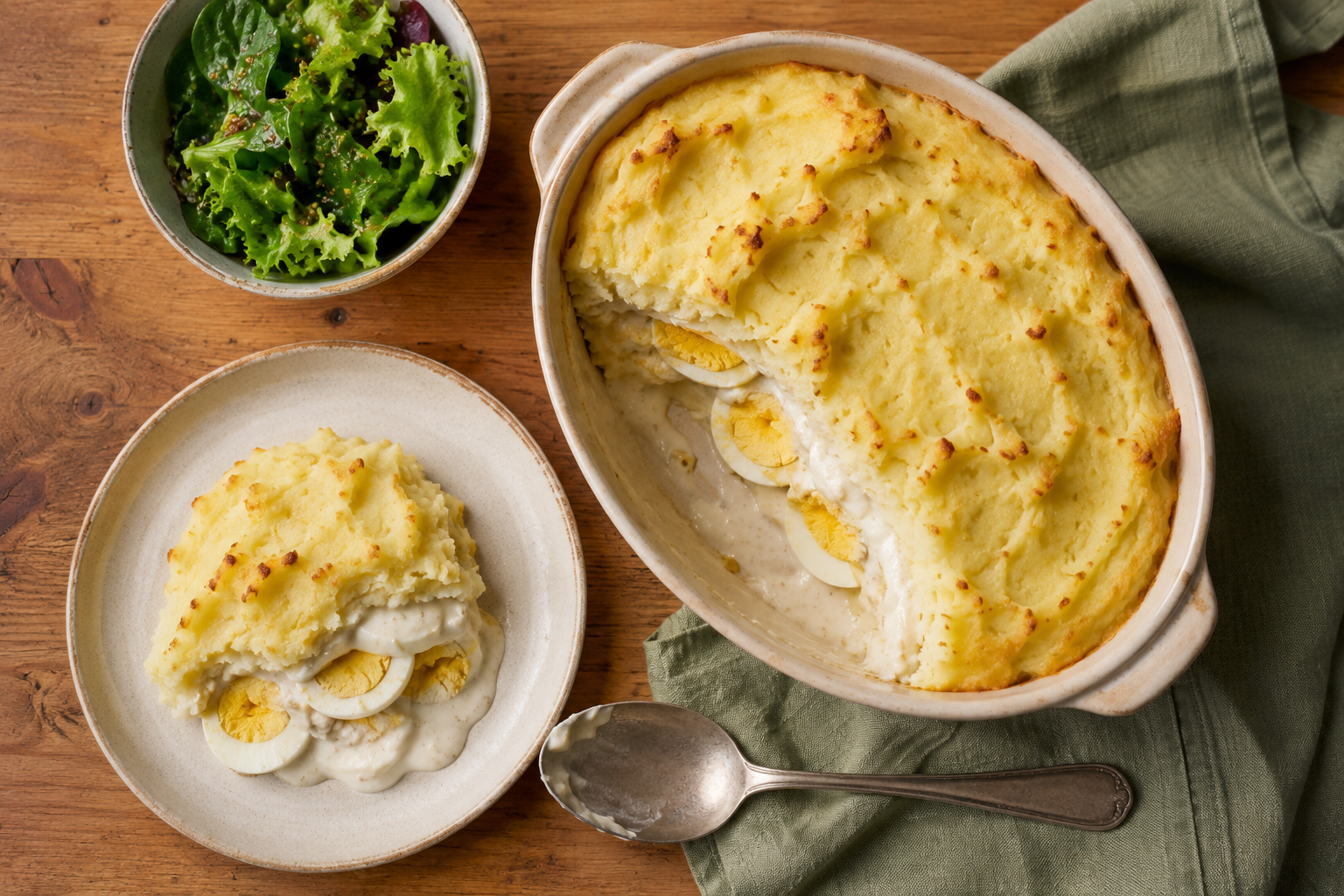
Quebec Egg and Potato Casserole
Equipment
- Medium saucepan for the potatoes
- Small saucepan for the eggs
- Colander
- Potato masher
- Medium saucepan for the béchamel
- Whisk
- Mixing bowl
- Rubber spatula or wooden spoon
- 2-quart or 2-litre baking dish
- Small knife
Ingredients
- 6 large eggs
- 2 lb yellow or russet potatoes
- 3½ tbsp butter melted
- ⅓ cup milk warmed
- 1½ tbsp finely chopped fresh parsley
- ½ tsp salt (small, Cara Cara, or Valencia)
- ¼ tsp freshly ground black pepper
For the béchamel sauce
- ¼ cup butter
- ¼ cup all-purpose flour
- 2 cup milk warmed
- 1/2 tsp nutmeg powder
- Salt and freshly ground black pepper to taste
Instructions
Cook the eggs
Place the eggs in a saucepan and cover them with cold water.Bring the water to a boil, then remove the saucepan from the heat, cover it and let the eggs stand for 10 to 12 minutes.Transfer the eggs to a bowl of cold water. Once cool enough to handle, peel them and cut them into slices. Set aside.Prepare the potatoes
Peel the potatoes and cut them into evenly sized pieces. Place them in a large saucepan and cover with cold, lightly salted water.Bring to a boil, then reduce the heat and simmer for approximately 15 minutes, or until the potatoes are completely tender when pierced with a fork.Drain them thoroughly and return them to the warm saucepan for one minute to allow any remaining moisture to evaporate.Mash the potatoes until smooth.Make the béchamel
While the potatoes are cooking, melt ¼ cup of butter in a medium saucepan over medium heat.Sprinkle in the flour and whisk continuously for approximately 30 seconds. The mixture should be smooth and lightly bubbling, but it should not brown.Gradually add the warm milk, whisking constantly to prevent lumps.Continue cooking and stirring until the sauce thickens enough to lightly coat the back of a spoon, approximately 5 to 7 minutes.Season with the nutmeg powder, the salt and pepper, then remove the sauce from the heat.Finish the mashed potatoes
Preheat the oven to 350°F (180°C). Lightly butter a 2-quart or 2-litre baking dish.Place the mashed potatoes in a large bowl. Add the melted butter, warm milk, parsley, salt and pepper.Mix until smooth and evenly combined. Taste and adjust the seasoning if necessary.Assemble the casserole
Spread half of the mashed potato mixture evenly over the bottom of the prepared baking dish.Arrange the sliced hard-boiled eggs over the potatoes, slightly overlapping them if necessary.Pour the béchamel sauce evenly over the eggs.Carefully spoon the remaining mashed potatoes over the sauce. Gently spread them to cover the surface without disturbing the layers underneath.For a more rustic finish, use the back of a spoon to create a few shallow swirls or ridges on top.Bake
Bake uncovered for 30 minutes, or until the casserole is hot throughout and the edges are beginning to bubble.If you would like a more golden surface, place the dish under the broiler for 2 to 3 minutes at the end of cooking. Watch it closely so that the potatoes do not burn.Allow the casserole to rest for 5 to 10 minutes before serving.
Notes
A Small Note Before You Begin
The mashed potatoes should be soft enough to spread, but not loose or watery. The exact amount of milk needed can vary depending on the variety of potato used. Begin with most of the milk and add the remainder only if the potatoes seem too firm. Keeping the purée relatively thick will help the finished casserole hold its layers when served.Tips for the Best Texture
- Drain the potatoes thoroughly before mashing them. Excess water can make the casserole loose.
- Warm the milk before adding it to both the potatoes and the béchamel.
- Slice the eggs only after they have cooled so they remain neat and do not crumble.
- Season each component separately. Potatoes, eggs and white sauce are all mild, so proper seasoning makes an important difference.
- Let the casserole rest briefly after baking. It will still be creamy, but the portions will hold together more easily.
Using Leftover Mashed Potatoes
This recipe is especially practical when you already have mashed potatoes in the refrigerator.
You will need approximately 3¼ cups. Warm them slightly, then stir in enough milk to make them easy to spread. If the potatoes already contain butter and seasoning, taste them before adding the full quantities listed in the recipe.
Once the eggs and béchamel are prepared, the casserole can be assembled and baked as directed.
Substitutions and Variations
The beauty of this recipe lies in its simplicity, but a few small adaptations can be made without changing its essential character.
- Replace the fresh parsley with finely chopped chives.
- Add a small pinch of ground nutmeg to the béchamel.
- Use half milk and half light cream for a richer sauce.
- Sprinkle a very light layer of breadcrumbs over the potatoes before baking for additional texture.
- Add a handful of cooked spinach between the eggs and béchamel to incorporate another vegetable.
These are optional additions rather than part of the regional recipe that inspired this version.
What to Serve with It
Because the casserole is creamy and filling, it pairs best with something fresh or lightly acidic.
Serve it with:
- A simple green salad with mustard vinaigrette
- Steamed green beans
- Roasted carrots
- Pickled beets
- Cucumber salad
- Sautéed cabbage
- Seasonal tomatoes with salt and vinegar
For a particularly simple supper, a green salad and a few pickles are all that is needed.
How to Store and Reheat It
Allow the casserole to cool, then cover the baking dish or transfer the leftovers to an airtight container.
Store in the refrigerator for up to three days.
Reheat individual portions in the microwave, or cover the baking dish with foil and warm it in a 325°F (165°C) oven until heated through. Adding a small spoonful of milk before reheating can help keep the potatoes creamy.
Because the recipe contains cooked eggs and a milk-based sauce, it should not be left at room temperature for more than two hours.
From Quebec’s Old Kitchens
From Quebec’s Old Kitchens is a series devoted to rediscovering the quieter side of Quebec’s culinary heritage: regional dishes made with familiar ingredients, shaped by seasonality, economy and everyday family life.
This egg and potato casserole comes from a regional recipe associated with the Fjord-du-Saguenay area of Saguenay–Lac-Saint-Jean.
Like the Côte-Nord cucumber soup that began this series, it offers a reminder that practical cooking does not have to feel plain or incomplete. With a few affordable ingredients and a thoughtful method, potatoes and eggs become a warm family meal worth bringing back to the table.
Did you make this recipe?
Please let me know how it turned out for you! Leave a comment below and tag @thesmallplenty on Instagram and hashtag it #thesmallplenty.