
Let’s start at the beginning.
With the simple things.
The things we once made at home before they were replaced by ready-made products, attractive packaging, and clever marketing.
These days, it is impossible to ignore the rising cost of groceries. Some foods have increased more than others, of course, but for most families, the overall grocery bill has become considerably more expensive.
So I started wondering what I could do, in my own small way, to regain a little control over our food and our family budget. After watching a documentary about ultra-processed foods, I made a decision: I was going to try to cook more things from scratch for my little family.
Not perfectly. Not absolutely everything. Just a little more, whenever it made sense.
But Where Do You Begin?
The answer will probably be different for every family. In my case, I decided to start with butter.
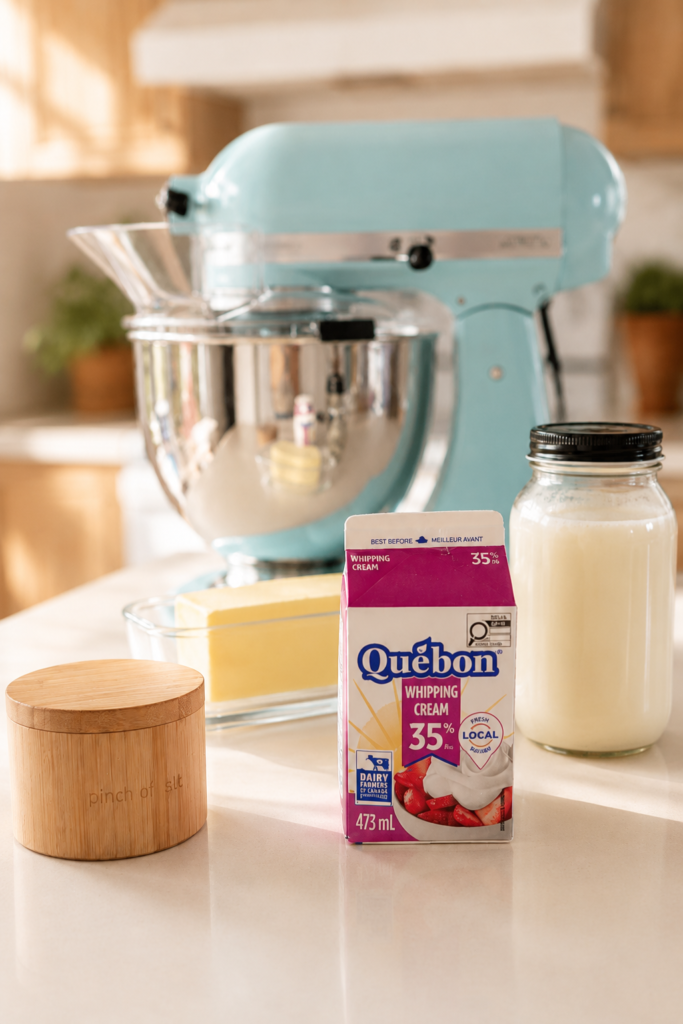
We use butter in so many recipes—perhaps even more when, like me, you grew up in France—and yet we often forget how easy it is to make. With an electric mixer or stand mixer, all you need to do is whip heavy cream long enough for the butterfat to separate from the liquid.
And the result is incomparable.
Homemade butter has a fresh, rich, delicate flavour that I rarely find in ordinary grocery-store butter in North America. Spread over a warm slice of bread, folded into mashed potatoes, or melted over seasonal vegetables, it can immediately transform something very simple.
That is exactly the kind of cooking I want to share here: approachable preparations made with just a few ingredients, which can then be used to make several other meals.
One simple foundation, followed by another recipe.
In this case, the cream becomes butter, and the liquid left behind will be used in our next batch of homemade pancakes.
Why Make Your Own Butter?
Making butter at home will not necessarily be less expensive in every situation. It depends on the price of cream where you live, the type of butter you usually buy, and the sales available in your area.
But homemade butter offers several advantages:
- It requires only one main ingredient.
- You can control exactly how much salt it contains.
- It gives you both butter and leftover churning liquid.
- Buying cream in a larger container may help reduce packaging.
- Most importantly, it tastes absolutely delicious.
From one litre, or approximately four cups, of 35% whipping cream, I generally obtain around 400 grams, or 14 ounces, of butter, along with a generous quantity of churning liquid. The exact yield can vary depending on the cream and how thoroughly the liquid is removed.
To determine whether making butter is worthwhile for you, compare the price of one litre of cream with the price of approximately 400 grams of the butter you usually buy.
Remember to include the leftover liquid in your calculation. It can be used in pancakes, waffles, muffins, quick breads, biscuits, and even some salad dressings.
Two useful kitchen staples from one ingredient—that is exactly the spirit of The Small Plenty.
Choosing the Right Cream
To make butter, you need cream with a high enough fat content. Heavy or whipping cream containing 35% milk fat works perfectly.
Whenever possible, I choose good-quality cream at a reasonable price. If you have access to a nearby farm or local dairy, it is worth asking what they offer. Local products are not always more expensive, and the quality can be remarkable.
Otherwise, larger containers are often more economical. Here in Canada, I sometimes use the large-format 35% whipping cream sold at Costco when the price is worthwhile.
Avoid using light cream. Its fat content is too low to produce a good butter yield.
Is Butter Healthy?
Let’s be clear: butter is not a magical food. Making it at home does not mean we should suddenly add unlimited amounts of it to everything we eat.
Butter is a rich, energy-dense fat that contains a significant amount of saturated fat. Current nutritional recommendations therefore continue to encourage consuming it in moderation.
But moderation does not necessarily mean exclusion.
I think it is unfortunate that butter was reduced for so long to something inherently “bad.” When it is made simply from cream, it is a minimally processed food with an ingredient list that is very easy to understand.
Butter naturally contains vitamin A, which helps support vision and the normal function of the immune system. Dietary fats also help our bodies absorb fat-soluble vitamins, including vitamins A, D, E, and K.
And then there is the flavour.
A small amount of good butter can bring an enormous amount of flavour to a dish. A pat melted over hot vegetables, a spoonful folded into mashed potatoes, or a thin layer spread over fresh bread can be enough to turn something very simple into a genuine moment of pleasure.
That is probably where butter finds its rightful place in my kitchen: not as something to use without limits, but as a valuable ingredient—one that I understand, appreciate, and use intentionally.
My goal is not to make my family follow a perfect, strict, joyless diet. I simply want to cook more at home, better understand the ingredients we eat, gradually reduce our reliance on ultra-processed foods, and rediscover the pleasure found in simple things.
Making your own butter is a lovely place to begin.
What Is the Liquid Left Behind?
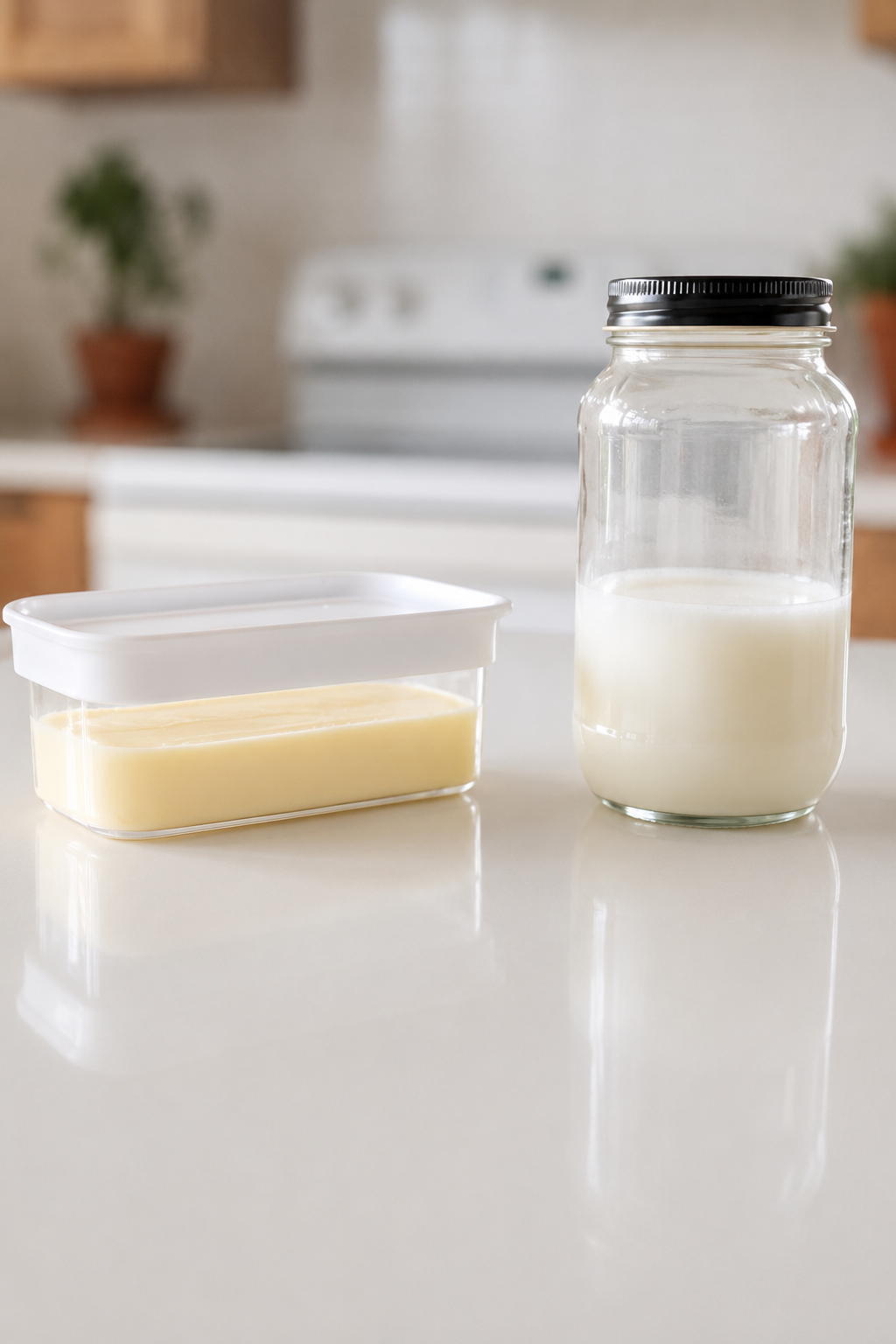
When the butterfat separates from the cream, it releases a thin, milky liquid. This is the liquid left over from churning and is often casually referred to as homemade buttermilk.
It is important, however, to distinguish it from the cultured buttermilk sold in grocery stores. Store-bought buttermilk is fermented, thicker, and more acidic. The liquid produced when making butter from sweet cream is thinner and has a much milder flavour.
You can still use it in many recipes, including pancakes, waffles, muffins, quick breads, biscuits, and salad dressings. Because it is less acidic than cultured buttermilk, it may behave slightly differently in recipes that rely on acidity for flavour or leavening.
Most importantly, do not throw it away. It will become the starting point for our next recipe: soft and fluffy homemade pancakes.
Ingredients
Method
- Pour the cold cream into the bowl of a stand mixer or a large, deep mixing bowl.
- Whip the cream at medium-high speed. It will first become whipped cream, then grow thicker and begin to look slightly grainy.
- Continue mixing. After several minutes, the butterfat will suddenly separate from a thin, milky liquid. Reduce the mixer speed at this stage to prevent splashing.
- Continue mixing until the pieces of butter begin to gather around the whisk or beaters. With my stand mixer set to speed 6, the separation generally begins after approximately 11 minutes, although the exact timing will vary depending on your appliance and the temperature of the cream.
- Place a fine-mesh strainer over a bowl, then pour in the contents of the mixing bowl. Set the collected liquid aside for another recipe.
- Gently press the butter with a spatula to remove as much of the remaining liquid as possible.
- Transfer the butter to a bowl of very cold water. Press and fold it several times, then replace the water when it becomes cloudy. Repeat until the water remains almost clear. This removes more of the liquid and helps the butter stay fresh longer.
- Drain the butter thoroughly. If you are making salted butter, work in the salt until it is evenly distributed.
- Shape the butter, transfer it to an airtight container, and refrigerate. If desired, sprinkle it with a little flaky sea salt before serving.
How to Use Homemade Butter
The most difficult part may be resisting the temptation to eat all of it immediately on fresh bread.You can also use it:In mashed potatoesOver roasted vegetablesTo finish a sauceIn cookies or muffinsOver hot cornOn warm biscuitsOr simply spread over a slice of bread with a pinch of flaky sea saltStore the leftover churning liquid in an airtight container in the refrigerator. We will use it very soon to make soft, fluffy homemade pancakes.One simple preparation leading naturally to the next—that is how we will build a more thoughtful, economical kitchen, one recipe at a time.